Granddaddy Purple, and why the color isn't the point
Purple Urkle meets Big Bud in the Bay Area, around 2003. Grape candy and dark berries over earth, and a short lesson in what purple buds do and do not mean.
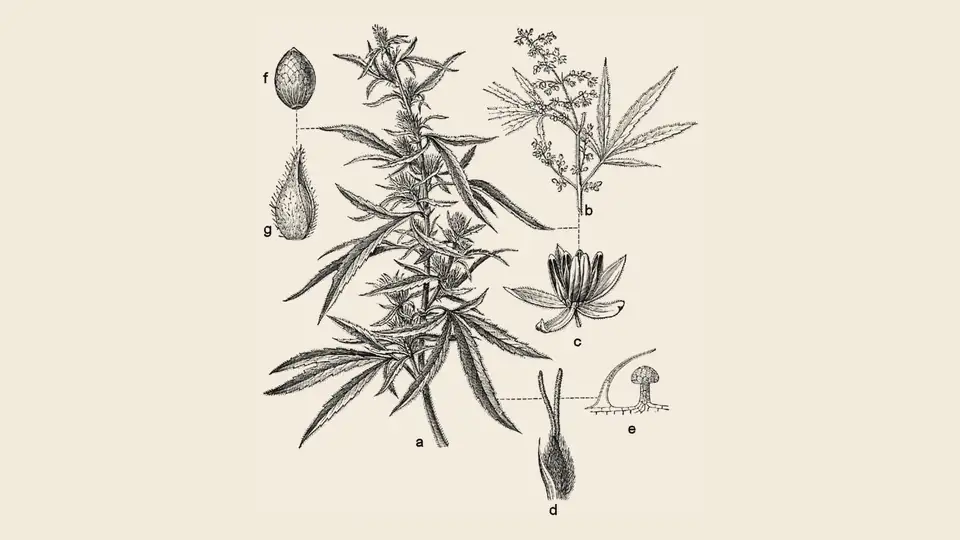
Granddaddy Purple, or GDP, is a California indica bred around 2003 from Purple Urkle and Big Bud, and credited to the breeder Ken Estes. It smells of grape candy and dark berries over earth. Lab reports usually lead with myrcene, and hemp-lane THCA listings commonly fall between the mid-teens and the low 20s percent, as of October 3, 2026.
| Specimen label | Granddaddy Purple (GDP) |
|---|---|
| Lineage | Purple Urkle × Big Bud |
| Breeder | Credited to Ken Estes, California, about 2003 |
| Sold as | Indica |
| Nose | Grape candy, blackberry, sweet earth, a peppery finish |
| Lead terpenes, as typically reported | Myrcene, then caryophyllene and pinene |
| THCA, as commonly listed for hemp-lane flower | Mid-teens to low 20s (%) |
| Total THC | THCA × 0.877 + delta-9 THC |
Two parents, two jobs
Granddaddy Purple is one of the few classics whose cross is not much argued about. Ken Estes, a Bay Area grower active in California’s early medical market, is credited with crossing Purple Urkle and Big Bud in the early 2000s. Each parent did a clear job. Purple Urkle, an older California purple, brought the color and the grape. Big Bud, a heavy-yielding 1980s indica, brought size and density. The result is a short, stout plant with large, tight buds, which helped it spread through California dispensaries quickly in the 2000s.
The color, explained
GDP buds often show deep purple calyxes and sugar leaves under a frost of trichomes. The pigments are anthocyanins, a family of plant compounds that also colors blueberries, red cabbage and autumn leaves. Some cannabis genetics produce them readily, and cool night temperatures in the final weeks of flowering tend to bring the color out further. That is why the same GDP cut can come out deep violet one harvest and mostly green the next.
What the color does not tell you:
- Potency. Anthocyanins are not cannabinoids. A deeply purple bud can test lower in THCA than a green one.
- Flavor, on its own. The grape smell comes from the terpene and aroma profile, not from the pigment. Green GDP can smell just as grapey.
- Quality. Purple is a trait, not a grade. Judge the cure, the trichomes and the lab report.
The nose
Open a jar of good GDP and the first thing is sweet grape, close to grape candy or grape soda, with blackberry behind it. Under the fruit is a sweet, earthy base, and breaking a bud adds a little pepper and pine. The smoke is smooth and sweet when well cured, with the grape fading to earth on the exhale. Dry or old GDP loses the fruit first and smells mostly of hay and earth.
The terpene profile, as typically reported
| Terpene | Where it usually ranks | Approximate band on lab reports | What it adds |
|---|---|---|---|
| Myrcene | First | About 3–9 mg/g | Ripe dark fruit, earth |
| Beta-caryophyllene | Second | About 1–3 mg/g | Pepper, a warm finish |
| Pinene | Third | About 0.5–2 mg/g | Pine lift |
| Linalool, limonene, humulene | Supporting | Usually under 1.5 mg/g each | Floral, citrus, wood |
These bands are approximate, based on how GDP commonly reads on published lab menus, not on one Batch. The grape note itself is not one terpene you can point to on a panel; it is the combination of myrcene’s ripe-fruit base with smaller aromatic compounds, some of which standard COAs do not measure. A GDP whose panel looks right but smells of little has usually lost its top notes in drying or storage. Ross and ElSohly (Journal of Natural Products, 1996) showed how much the oil profile of cannabis shifts between fresh and dried buds.
What people report feeling
In public reviews GDP is described as “heavy”, “sedating”, “calm” and “body-focused”, with a slow onset that people say builds over twenty or thirty minutes. It is widely kept for evenings. Some reviewers describe it as dreamy rather than clear, and few call it a daytime strain.
Those are user reports, not measured effects. Dose, tolerance, setting and the name’s reputation all shape them. Not medical advice; not evaluated by the FDA.
Why one jar differs from the next
- Night temperatures. As above, the color changes with the season and the grow room.
- Big Bud’s legacy. The yield trait makes GDP tempting to push for weight. Overfed, rushed GDP produces big buds with a thin nose.
- Imitations. Many purple strains get sold as “Granddaddy” or “GDP” because the name is well known. Purple Punch, Purple Kush and Grape Ape are separate cultivars.
- Storage. The fruit is the fragile part. Kept warm or opened often, a pound of GDP loses its grape before it loses its potency.
Reading a GDP COA
Look for myrcene in first place by a clear margin and a terpene total of at least 1% by weight (10 mg/g) if you want the grape. Then compute total THC: a lot at 18% THCA and 0.2% delta-9 THC carries about 16% total THC (18 × 0.877 = 15.79, plus 0.2).
A note on December 11
OCTOBER 3, 2026 — A strain born in California’s medical gardens now sits in two very different legal lanes. In the licensed-dispensary lane, in states with adult-use cannabis, GDP is sold as marijuana under state licenses, and the coming federal change leaves that lane alone. In the hemp-retail lane it is sold as THCA flower that tested at or under 0.3% delta-9 THC, the measure set by 7 U.S.C. §1639o. Under P.L. 119-37, with its start date for natural cannabinoids moved by H.R. 6500 (signed September 2, 2026), hemp will be measured by total THC including THCA, at 0.3% dry weight, from December 11, 2026 (CRS In Focus IF13136). A GDP lot at 18% THCA is roughly fifty times over that limit, so it stops being hemp federally on that date unless Congress acts. California itself already treats high-THCA flower as outside its hemp lane, and so do a number of other states, so THCA flower is not legal everywhere even now.
Filed by the desk. Not legal advice.
Sources
- Ross and ElSohly, “The volatile oil composition of fresh and air-dried buds of Cannabis sativa,” Journal of Natural Products, 1996. doi.org/10.1021/np960004a
- 7 U.S.C. §1639o. law.cornell.edu
- Congressional Research Service, In Focus IF13136, August 17, 2026. everycrsreport.com
- H.R. 6500, 119th Congress. congress.gov
How we wrote this: lineage from the published record on the cross and its breeder; terpene ranks from published lab menus; effects summarized from public user reports. Last reviewed October 3, 2026.
The federal hemp rule · December 11, 2026On December 11, 2026 the federal definition of hemp starts counting THCA toward the 0.3% total-THC limit, and flower like most of this shelf will no longer qualify. Until then it is sold as hemp, and this note will be rewritten the day the rule takes effect.Filed by the desk.
Questions
What is Granddaddy Purple a cross of?
Purple Urkle crossed with Big Bud. The cross is credited to the California breeder Ken Estes and dated to about 2003.
Why is Granddaddy Purple purple?
Anthocyanins, the same family of pigments that colors blueberries and red cabbage. GDP's genetics make them likely, and cool nights near harvest bring them out more. The color does not indicate potency.
What does Granddaddy Purple smell like?
Grape candy and dark berries over an earthy, slightly sweet base. Lab reports usually put myrcene first, with caryophyllene and pinene behind.
Is GDP an indica?
Yes. Both parents are indica-leaning, and GDP is sold as an indica.
How we wrote this. Set down by THCA Life editorial desk for THCA Life. Every change is dated above. Corrections are welcome at hello@thcalife.com.