Durban Poison, a landrace with a licorice nose
A sativa from the KwaZulu-Natal coast that kept its name through fifty years of travel. Anise, fennel and sweet herbs, from the rarer terpinolene family.
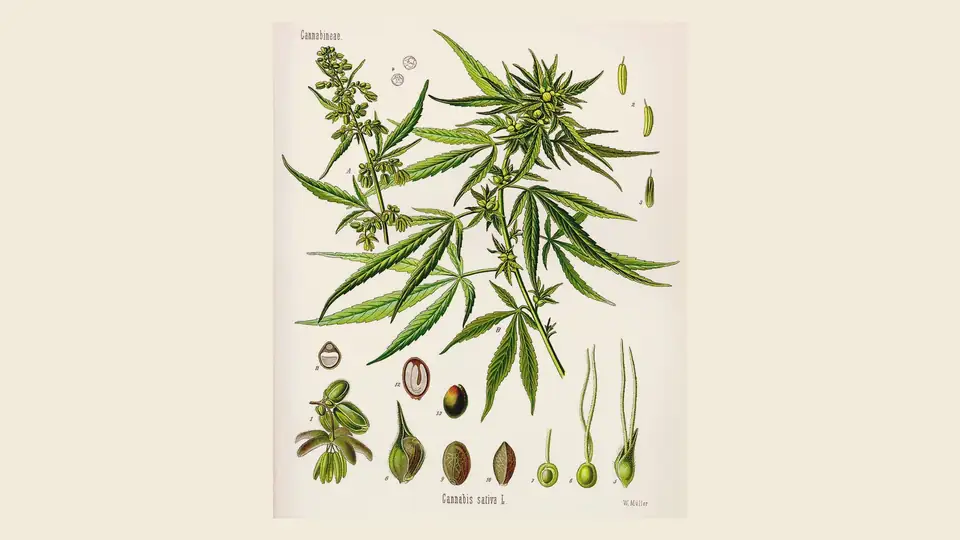
Durban Poison is a sativa descended from a landrace grown around Durban, South Africa, and carried to the US and Europe from the 1970s. It smells of anise, fennel and sweet herbs, and its lab reports usually lead with terpinolene. Hemp-lane listings commonly show THCA from the high teens to the low 20s percent, as of October 3, 2026.
| Specimen label | Durban Poison |
|---|---|
| Lineage | South African landrace from the Durban area; some seed versions add an indica |
| First circulated | US from the 1970s; Dutch seed catalogs from the 1980s |
| Sold as | Sativa |
| Nose | Anise, fennel seed, sweet herbs, pine, a little citrus |
| Lead terpenes, as typically reported | Terpinolene, then myrcene and ocimene |
| THCA, as commonly listed for hemp-lane flower | High teens to low 20s (%) |
| Total THC | THCA × 0.877 + delta-9 THC |
A landrace that traveled
A landrace is a local variety that farmers kept and replanted in one place for generations, so it adapted to that climate. Durban Poison’s ancestors grew in the hot, humid coastal belt of KwaZulu-Natal. The usual story credits the American writer and grower Ed Rosenthal with bringing seed back to the United States in the 1970s. The line was then worked by growers in California and by Dutch seed companies in the 1980s, who selected for shorter flowering and denser buds.
That selection is the important part. The Durban Poison in jars today is the descendant of a landrace, not the landrace itself. The Dutch seed company Dutch Passion, one of the oldest sellers of the name, lists its own Durban Poison® as “Durban X Unknown Indica” with an eight-week flowering time. Other lines claim to be pure. If purity matters to you, ask which line the grower used.
The nose
Durban Poison is easy to pick out blind. The first note is anise: licorice, fennel seed, star anise. Behind it are sweet green herbs, a pine edge and sometimes a thin line of lemon. Ground, it turns sharper and more resinous. The smoke is light and clean when well cured, with the anise lingering on the exhale. People who dislike licorice tend to know at the first sniff.
Buds are often long, tapering and less dense than indica-led strains, with bright green color and orange pistils. That shape is normal for the strain and not, by itself, a sign of low quality.
The terpene profile, as typically reported
| Terpene | Where it usually ranks | Approximate band on lab reports | What it adds |
|---|---|---|---|
| Terpinolene | First | About 2–8 mg/g | Anise, pine, fresh herbs |
| Myrcene | Second | About 1–3 mg/g | Soft earthy base |
| Ocimene | Second or third | About 0.5–2 mg/g | Sweet, green, slightly floral |
| Pinene, limonene, caryophyllene | Supporting | Usually under 1.5 mg/g each | Resin, citrus, pepper |
These bands are approximate and come from how Durban Poison commonly reads on published lab menus, not from one Batch.
Durban Poison belongs to the terpinolene group, the least common of the three chemical groups that Smith and colleagues (PLOS ONE, 2022) found among 89,923 US lab samples. They also noticed that this group carried modestly more CBG, a minor cannabinoid, than the others (median 0.98% against 0.65%). That is a pattern across many strains, not a Durban Poison figure, but it is a reason to read the minor-cannabinoid lines on a Durban COA instead of skipping to THCA.
What people report feeling
Public reviews of Durban Poison use words like “energetic”, “clear”, “focused”, “talkative” and “bright”. It is one of the strains people name when asked for a daytime choice, and some describe it as having little body weight compared with hybrids. A minority report it as “jittery” or “too speedy”, usually at higher doses.
Those are users’ reports, not measured effects, and they are shaped by dose, tolerance, setting and the strain’s reputation. Not medical advice; not evaluated by the FDA.
Why one bag differs from the next
- Which line. “Pure” landrace descendants, Dutch lines with an indica added, and newer crosses all sell as Durban Poison. They differ in bud density, flowering time and how strong the anise is.
- Climate. Durban Poison evolved in heat and long seasons. Grown indoors under good light it holds its shape; rushed or cold grows give thin buds and a flat nose.
- Terpinolene’s volatility. It is one of the first terpenes to fade with warmth and air. An old or warm-stored bag loses the licorice and keeps the pine.
- Harvest timing. A sativa that finishes over weeks invites early harvest. Early lots smell greener and read lower on terpenes.
Reading a Durban Poison COA
Check that terpinolene leads. If myrcene dominates heavily with caryophyllene second, the jar may be a different line or a mislabel. Look at the CBG line while you are there. Then compute total THC: a lot at 22% THCA and 0.18% delta-9 THC carries about 19.5% total THC (22 × 0.877 = 19.29, plus 0.18).
What changes on December 11
OCTOBER 3, 2026 — Durban Poison reaches American buyers through two lanes. In the hemp-retail lane it is sold as THCA flower that tested at or below 0.3% delta-9 THC, the federal hemp test in 7 U.S.C. §1639o. In the licensed-dispensary lane, in adult-use states, it is sold as marijuana under state licenses. The first lane narrows on December 11, 2026. P.L. 119-37 redefined hemp by total THC, counting THCA, at 0.3% dry weight, and H.R. 6500, signed September 2, 2026, pushed the start date for natural cannabinoids to December 11 (CRS In Focus IF13136). From then on, Durban Poison at normal potency is not hemp federally unless Congress acts. The dispensary lane is unchanged. State rules already vary, and THCA flower is not legal to buy as hemp in every state now.
Filed by the desk. Not legal advice.
Sources
- Dutch Passion, Durban Poison® product page (accessed October 3, 2026). dutch-passion.com
- Smith and others, “The phytochemical diversity of commercial Cannabis in the United States,” PLOS ONE, 2022. doi.org/10.1371/journal.pone.0267498
- 7 U.S.C. §1639o. law.cornell.edu
- H.R. 6500, 119th Congress. congress.gov
- Congressional Research Service, In Focus IF13136, August 17, 2026. everycrsreport.com
How we wrote this: history from published accounts and a seed company’s own listing, with the travel story marked as the usual account; terpene ranks from the cited study and published lab menus; effects summarized from public user reports. Last reviewed October 3, 2026.
The federal hemp rule · December 11, 2026On December 11, 2026 the federal definition of hemp starts counting THCA toward the 0.3% total-THC limit, and flower like most of this shelf will no longer qualify. Until then it is sold as hemp, and this note will be rewritten the day the rule takes effect.Filed by the desk.
Questions
Is Durban Poison a pure sativa?
It is sold as one and descends from a South African landrace around Durban. Some commercial seed versions are not pure: Dutch Passion lists its Durban Poison as Durban crossed with an unknown indica.
Why does Durban Poison smell like licorice?
Its lab reports usually lead with terpinolene, often with ocimene and myrcene behind it. Together they read as anise, fennel, sweet herbs and pine.
What terpene is dominant in Durban Poison?
Terpinolene, as typically reported. That places it in the least common of the three main terpene groups found in a 2022 study of 89,923 US lab samples.
Where does the name come from?
From Durban, the port city on South Africa's KwaZulu-Natal coast where the landrace was collected. 'Poison' is slang for its strength, not a warning about contents.
How we wrote this. Set down by THCA Life editorial desk for THCA Life. Every change is dated above. Corrections are welcome at hello@thcalife.com.