Northern Lights, the indica everyone borrowed
An Afghani-led indica that left the Pacific Northwest for Holland and became a parent to half the classics on this list. Musk, honey and damp earth.
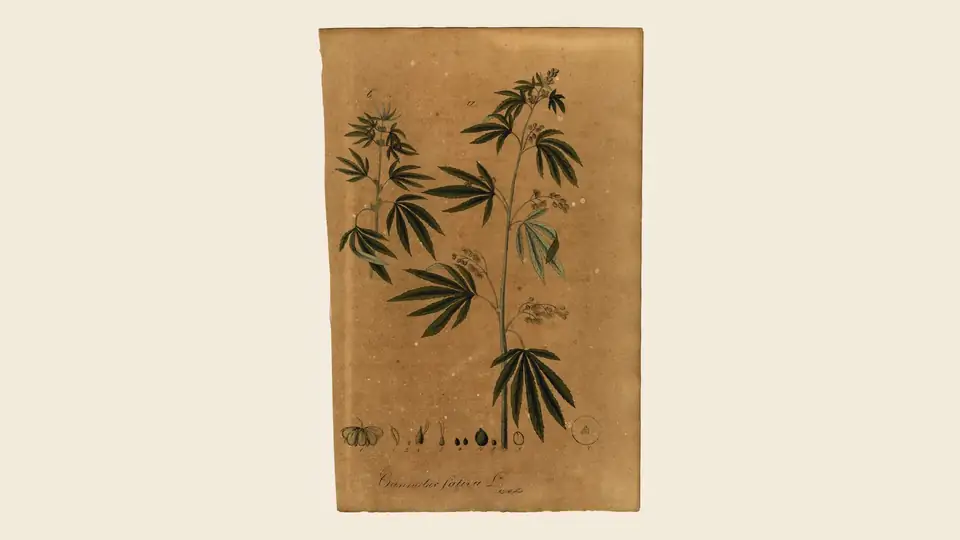
Northern Lights is a mostly Afghani indica traced to the US Pacific Northwest and refined by Sensi Seeds in the Netherlands. The breeder lists it as 90% indica with a 45–50 day flowering time. It smells musky, sweet and earthy, with honey, and lab reports usually lead with myrcene, as of October 3, 2026.
| Specimen label | Northern Lights |
|---|---|
| Lineage | Afghani landrace stock with some Thai, per the breeder |
| First circulated | Pacific Northwest, late 1970s to early 1980s; in the Netherlands from the mid-1980s |
| Sold as | Indica (Sensi lists its regular seeds as 90% indica) |
| Nose | Musk, honey, damp earth, a little pine |
| Lead terpenes, as typically reported | Myrcene, then caryophyllene and pinene or limonene |
| THCA, as commonly listed for hemp-lane flower | Mid-teens to low 20s (%) |
| Total THC | THCA × 0.877 + delta-9 THC |
From a Seattle-area garden to a Dutch catalog
The usual account starts with growers near Seattle working with Afghani seed in the late 1970s and numbering their selections; “Northern Lights #1” through “#11” circulated, and #5 became the famous one. In the mid-1980s the line reached the Netherlands, where Sensi Seeds developed it into a stable seed variety. Sensi’s own Northern Lights page is careful about the American chapter: the strain “is thought to have originated in the States”, and Sensi “developed it into the variety that it is today, enhancing its Afghani and Thai genetics”.
From there it became breeding stock. Northern Lights #5 is commonly listed as a grandparent of Jack Herer, a parent of Shiva Skunk and a parent of Super Silver Haze. When a modern indica smells of musk and hash, there is a fair chance Northern Lights is somewhere in the family tree.
What growers liked, and what it means for the flower
Sensi lists the plant as compact (around 80–130 cm indoors), heavy-yielding and fast, with a 45–50 day flowering period. Those traits are why breeders used it. For the person opening a jar, they mean dense, rounded buds with heavy resin and fewer of the long, foxtailed shapes common in Haze lines. A good lot feels solid between the fingers and breaks into sticky pieces rather than crumbs.
The nose
Northern Lights is a quiet strain in the jar. The breeder’s words are “musky, sweet and earthy” and “a hint of honey”, and that matches what most people notice: a soft, rounded smell, like damp soil and beeswax, with a light pine note when the bud is broken. It is the opposite of a loud fuel or candy strain. The smoke is smooth and earthy; some people find a hashy, spiced finish.
The terpene profile, as typically reported
| Terpene | Where it usually ranks | Approximate band on lab reports | What it adds |
|---|---|---|---|
| Myrcene | First | About 3–10 mg/g | Musk, earth, ripe fruit |
| Beta-caryophyllene | Second | About 1–3 mg/g | Pepper, warmth |
| Pinene or limonene | Third | About 0.5–2 mg/g | Pine, a faint sweetness |
| Humulene, linalool | Supporting | Usually under 1 mg/g each | Wood, a floral trace |
These bands are approximate, based on how Northern Lights commonly reads on published lab menus. They are not one Batch’s results. Myrcene-heavy flower with pinene behind it fits the “high myrcene-pinene” group identified by Smith and colleagues (PLOS ONE, 2022) in 89,923 US lab samples, which was one of the two groups that together held 87.4% of THC-dominant flower.
What people report feeling
The words that come up in public reviews are “heavy”, “calm”, “body”, “melting” and “couch”. People describe the effect building slowly through the body, with less mental chatter than a Haze or Diesel strain, and many say they keep it for the end of the day. Some describe it as hard to get up from.
Those are user reports, not measured effects. Dose, tolerance and setting shape them. Not medical advice; not evaluated by the FDA.
Why one jar of Northern Lights differs from the next
- Number and source. “Northern Lights” on a menu may be Sensi’s seed line, a numbered cut such as #5, an autoflowering version, or a local cross. Autoflowering versions carry ruderalis genetics and often read lighter on terpenes.
- Its own quietness. Because the aroma is soft to begin with, small losses in drying and storage are more noticeable. A Northern Lights that smells of nothing much has usually been dried too fast or stored too warm.
- Harvest timing. A short flowering plant gives growers less room for error. A week either side changes the balance between the sweet top notes and the earthier base.
- Grade. Indoor lots tend to show the honey; outdoor and greenhouse lots can lean more to earth and hay.
Reading a Northern Lights COA
Look for a terpene panel with myrcene clearly first. Total terpenes under about 1% by weight (10 mg/g) usually mean a flat jar, whatever the potency. Then do the total THC sum: a lot at 19% THCA and 0.25% delta-9 THC carries about 16.9% total THC (19 × 0.877 = 16.66, plus 0.25).
The two lanes, and the December date
OCTOBER 3, 2026 — Northern Lights is sold through two legal routes in the United States, and only one of them is about to close. The hemp-retail lane sells it as THCA flower that tests at or under 0.3% delta-9 THC, the test written into 7 U.S.C. §1639o in 2018. P.L. 119-37 replaced that test with a total-THC limit of 0.3% by dry weight that counts THCA (CRS In Focus IF13136), and H.R. 6500, signed September 2, 2026, starts that limit for flower on December 11, 2026. After that date, high-THCA Northern Lights is marijuana under federal law unless Congress changes course again. The licensed-dispensary lane, in states with adult-use cannabis, is governed by state licenses and is not touched by the hemp redefinition. Several states already keep THCA flower out of their hemp shops, so it is not legal everywhere even now.
Filed by the desk. Not legal advice.
Sources
- Sensi Seeds, Northern Lights® regular seeds, product page (accessed October 3, 2026). sensiseeds.com
- Smith and others, “The phytochemical diversity of commercial Cannabis in the United States,” PLOS ONE, 2022. doi.org/10.1371/journal.pone.0267498
- 7 U.S.C. §1639o. law.cornell.edu
- Congressional Research Service, In Focus IF13136, August 17, 2026. everycrsreport.com
- H.R. 6500, 119th Congress. congress.gov
How we wrote this: history and plant traits from the breeder’s own page, with the American origin story marked as the usual account; terpene ranks from the cited study and published lab menus; effects summarized from public user reports. Last reviewed October 3, 2026.
The federal hemp rule · December 11, 2026On December 11, 2026 the federal definition of hemp starts counting THCA toward the 0.3% total-THC limit, and flower like most of this shelf will no longer qualify. Until then it is sold as hemp, and this note will be rewritten the day the rule takes effect.Filed by the desk.
Questions
Where does Northern Lights come from?
It is usually traced to growers in the US Pacific Northwest in the late 1970s and early 1980s, then developed by Sensi Seeds in the Netherlands. Sensi says it was 'thought to have originated in the States' and has Afghani and Thai genetics.
Is Northern Lights an indica?
Yes. Sensi Seeds lists its regular Northern Lights as 90% indica and 10% sativa, with a 45–50 day flowering time.
What does Northern Lights smell like?
Musky, sweet and earthy, with a honeyed note and a little pine. Its lab reports usually put myrcene first.
Which strains descend from Northern Lights?
Northern Lights #5 is commonly given as a grandparent of Jack Herer and a parent of Shiva Skunk and Super Silver Haze, among many others.
How we wrote this. Set down by THCA Life editorial desk for THCA Life. Every change is dated above. Corrections are welcome at hello@thcalife.com.