White Widow, and what the frost does and doesn't tell you
Amsterdam, the mid-1990s: a Brazilian sativa meets a South Indian indica and comes out white with resin. Wood, pepper and earth, and a lesson about frost.
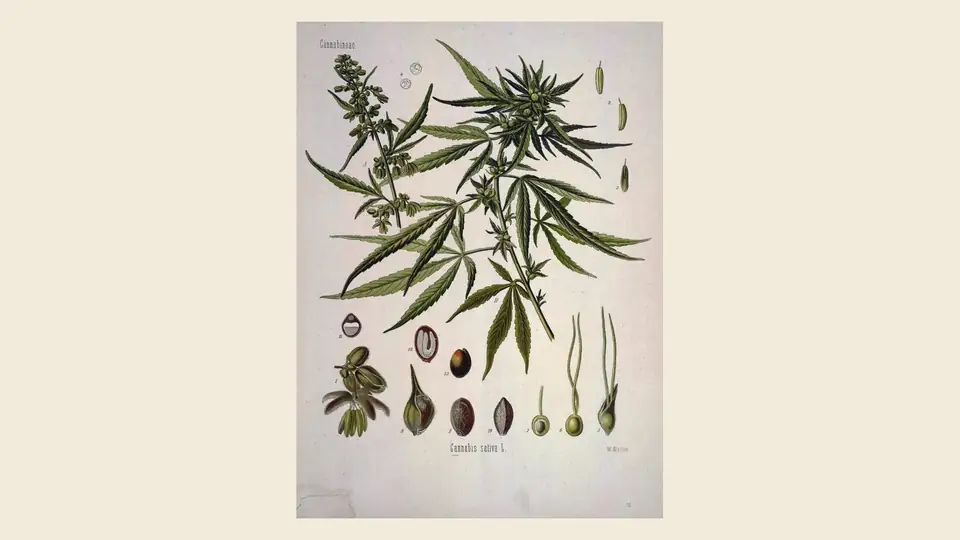
White Widow is a hybrid of a Brazilian sativa and a South Indian indica, released in Amsterdam in the mid-1990s and named for the white coat of resin on its buds. It smells earthy, woody and peppery, and lab reports usually lead with myrcene and caryophyllene. Hemp-lane listings commonly show THCA in the high teens to low 20s percent, as of October 3, 2026.
| Specimen label | White Widow |
|---|---|
| Lineage | Brazilian sativa landrace × South Indian indica, as commonly given |
| First circulated | Amsterdam, mid-1990s, through Green House Seed Co. |
| Sold as | Balanced hybrid |
| Nose | Damp wood, earth, cracked pepper, a faint sour citrus |
| Lead terpenes, as typically reported | Myrcene and caryophyllene, then pinene |
| THCA, as commonly listed for hemp-lane flower | High teens to low 20s (%) |
| Total THC | THCA × 0.877 + delta-9 THC |
An Amsterdam hybrid with a disputed author
White Widow arrived in the Dutch coffeeshop trade in the mid-1990s and was one of the strains that made Amsterdam’s seed companies famous abroad. It was sold through Green House Seed Co., and its reputation grew quickly through the cannabis-cup circuit of the time. The person usually credited with breeding it is Shantibaba, who worked with Green House then and later co-founded Mr. Nice Seeds. Who deserves the credit has been argued in interviews for decades; we note the argument and leave it there.
The parents are given almost everywhere as a Brazilian sativa landrace and a South Indian indica known for heavy resin. That is a believable pairing for what the plant does: tall-ish and vigorous, but finishing faster than a pure tropical sativa, and covered in trichomes.
The frost, read honestly
Trichomes are the small glands on the surface of the flower where cannabinoids and terpenes are made and stored. White Widow was selected for so many of them that the buds look sugared. That is the name.
It is worth being plain about what frost can and cannot tell you.
- It can tell you about handling. Trichome heads are fragile. Flower that has been trimmed roughly, tumbled, or packed loose and shaken in transit loses its white look and leaves a dusting in the bottom of the bag. A frosty bud is usually a gently handled bud.
- It can tell you a little about ripeness. Under a loupe, mostly cloudy heads suggest a harvest at peak; clear heads suggest early; many amber heads suggest late.
- It cannot tell you the THCA percentage. Coverage is visual. A very white bud can test lower than a darker one, and terpene content is not visible at all. The lab report is the only measure.
The nose
White Widow smells of the forest floor more than of fruit. Most people describe wet wood and earth first, then black pepper when the bud is broken, and a faint sour or citrus note at the very top. It is pungent rather than sweet. The smoke is woody and peppery; when it is harsh, the cure was usually rushed.
The terpene profile, as typically reported
| Terpene | Where it usually ranks | Approximate band on lab reports | What it adds |
|---|---|---|---|
| Myrcene | First or second | About 2–7 mg/g | Earth, musk |
| Beta-caryophyllene | First or second | About 1.5–4 mg/g | Pepper, dry wood |
| Pinene | Third | About 0.5–2 mg/g | Resin, a clean sharp edge |
| Humulene, limonene | Supporting | Usually under 1.5 mg/g each | Woody bitterness, faint citrus |
These are approximate bands, drawn from how White Widow commonly reads on published lab menus rather than from one Batch. Humulene tends to travel with caryophyllene (the plant often makes both with the same enzyme), so a White Widow with a strong pepper note often shows a small humulene line too. For the background on how plants build these compounds, Booth and Bohlmann (Plant Science, 2019) is a readable review.
What people report feeling
White Widow’s public reviews describe a balanced effect: “uplifting” and “social” at the start, then “relaxed” and “steady”. People call it a good afternoon strain, and many mention that it is strong for its age, a reputation that dates from the 1990s, when its potency was unusual. A smaller group report it as “foggy” at higher doses.
Those are user reports, not measured effects, and they depend on dose, tolerance and setting. Not medical advice; not evaluated by the FDA.
Why one lot differs from the next
- Thirty years of copies. White Widow has been grown from seed by thousands of gardens and sold by many seed companies. “White Widow” from one seed bank and from another may be meaningfully different plants. A 2019 genetic survey, Schwabe and McGlaughlin (Journal of Cannabis Research), found that same-name samples often did not match genetically.
- Crosses that keep the name. White Rhino, White Russian, Blue Widow and many other “White” or “Widow” strains are separate cultivars.
- Handling. As above, frost survives careful trimming and packing and does not survive rough handling.
- Cure. The woody, peppery side turns harsh and grassy if the flower is dried quickly. A slow cure is what makes it smooth.
Reading a White Widow COA
Look for myrcene and caryophyllene near the top, and do not let the photograph do the lab’s job. Then compute total THC. A lot at 20% THCA and 0.2% delta-9 THC carries about 17.7% total THC (20 × 0.877 = 17.54, plus 0.2).
Hemp, dispensaries and December 11
OCTOBER 3, 2026 — In the hemp-retail lane, White Widow is sold as THCA flower because federal law has, since 2018, measured hemp by delta-9 THC alone at 0.3% by dry weight (7 U.S.C. §1639o). On December 11, 2026, that test becomes a total-THC test that counts THCA, under P.L. 119-37 as delayed by H.R. 6500, signed September 2, 2026 (CRS In Focus IF13136). A White Widow lot near 20% THCA will not qualify as hemp after that date. In states with adult-use cannabis, licensed dispensaries sell it as marijuana, and that lane is set by state law, not by the hemp definition. Some states already exclude high-THCA flower from hemp retail, so THCA flower is not legal in every state today either.
Filed by the desk. Not legal advice.
Sources
- Schwabe and McGlaughlin, “Genetic tools weed out misconceptions of strain reliability in Cannabis sativa,” Journal of Cannabis Research, 2019. doi.org/10.1186/s42238-019-0001-1
- Booth and Bohlmann, “Terpenes in Cannabis sativa – from plant genome to humans,” Plant Science, 2019. doi.org/10.1016/j.plantsci.2019.03.022
- 7 U.S.C. §1639o. govinfo.gov
- H.R. 6500, 119th Congress. congress.gov
- Congressional Research Service, In Focus IF13136, August 17, 2026. everycrsreport.com
How we wrote this: history from the published record, with the breeding credit marked as disputed; terpene ranks from published lab menus; effects summarized from public user reports. Last reviewed October 3, 2026.
The federal hemp rule · December 11, 2026On December 11, 2026 the federal definition of hemp starts counting THCA toward the 0.3% total-THC limit, and flower like most of this shelf will no longer qualify. Until then it is sold as hemp, and this note will be rewritten the day the rule takes effect.Filed by the desk.
Questions
What is White Widow a cross of?
It is usually described as a Brazilian sativa landrace crossed with a resin-heavy South Indian indica, developed in Amsterdam in the mid-1990s.
Why is it called White Widow?
For the dense coat of white trichomes, the resin glands that cover the buds and small leaves. A well-grown lot looks dusted in frost.
Does more frost mean stronger flower?
Not reliably. Trichome coverage is a good sign of a careful grow and gentle handling, but THCA content and terpene levels are only known from a lab report.
Who bred White Widow?
It was released through Green House Seed Co. in Amsterdam. The breeder Shantibaba, who worked with Green House at the time and later co-founded Mr. Nice Seeds, is widely credited with creating it, and the credit has been argued over since.
How we wrote this. Set down by THCA Life editorial desk for THCA Life. Every change is dated above. Corrections are welcome at hello@thcalife.com.